Cut, Rearrange, Reimagine: How Collage Changed Art
From Picasso's radical experiments and Hannah Höch's political photomontages to the colourful worlds of Henri Matisse and Romare Bearden, the extraordinary creative possibilities of cutting things apart and putting them back together.
A photograph from an old magazine. A fragment of coloured paper. A piece of packaging, a newspaper headline or a ticket kept from a journey.
Individually, these objects might appear unremarkable.
They belong to the ordinary visual material of everyday life. Things we read, use, collect and often throw away.
But place them together in an unexpected arrangement, and something interesting can happen.
A familiar face acquires a different meaning. A piece of printed text becomes part of an abstract composition. Colours and shapes begin to form relationships that did not exist before.
An entirely new image emerges from fragments of existing ones.
This is the extraordinary possibility of collage.
Unlike traditional painting, where artists generally create an image through marks applied to a surface, collage allows existing materials to become part of the artwork itself.
The technique seems simple.
Cut something out. Move it. Attach it somewhere else.
Yet during the twentieth century, these modest actions helped transform modern art.
Artists began questioning established distinctions between painting and everyday objects, creating works that incorporated printed photographs, newspapers, wallpaper and ordinary paper.
The results could be playful, political, deeply personal or visually astonishing.
And the ideas behind them continue influencing contemporary art, graphic design and digital culture.
When Reality Entered the Painting
In 1912, Pablo Picasso created a small oval artwork that would become one of the most influential experiments in modern art.
Its title was Still Life with Chair Caning.
At first glance, the composition appears to be a complicated arrangement of familiar objects.
Fragments suggest a café table, drinking glass and other elements of an everyday scene.
But one section introduces something unusual.
The apparent woven surface of a chair is not painted.
It is a piece of commercially manufactured oilcloth printed with a chair-caning pattern.
Picasso attached the material directly to the canvas.
Around the edge, he added a real length of rope, creating an unconventional frame.
The decision was revolutionary within the context of modern European painting.
For centuries, painters had developed sophisticated techniques for representing objects convincingly.
They could create the appearance of fabric, wood, metal or stone.
Picasso introduced a different possibility.
Why paint an imitation of a material when an actual piece of manufactured material could become part of the composition?
The distinction between representation and reality suddenly became less clear.
The artwork was both a painting and a collection of physical objects.
Its meaning depended on their combination.
The Birth of a New Artistic Language
Picasso was not alone in exploring these ideas.
His close artistic collaborator, Georges Braque, was developing related experiments within Cubism.
During the autumn of 1912, Braque created Fruit Dish and Glass, using pieces of printed wallpaper alongside charcoal drawing.
The wallpaper imitated the appearance of wood.
But its role in the composition was more complicated than simply providing a realistic surface.
It introduced a manufactured fragment into an artwork built around abstraction and representation.
The material was simultaneously real paper and an imitation of something else.
This approach became known as papier collé, or pasted paper.
The technique opened new possibilities.
Newspaper fragments could introduce recognisable words.
Printed patterns could establish textures.
Different materials could create contrasts that would be difficult to achieve through painting alone.
Although assembling materials into decorative or artistic arrangements had a much longer history, Picasso and Braque helped establish collage as a radical language within modern Western art.
Their experiments questioned what could belong inside an artwork.
And once ordinary materials entered the composition, the possibilities expanded dramatically.
Berlin: Art With a Political Edge
A few years later, collage acquired a very different purpose.
In the aftermath of the First World War, Berlin became a centre of artistic experimentation and political instability.
Artists associated with the Dada movement challenged conventional ideas about art, authority and cultural respectability.
They rejected the assumption that artworks needed to be harmonious, beautiful or carefully composed according to traditional rules.
Instead, they embraced disruption.
Newspapers, photographs, advertisements and fragments of printed text became materials for creating deliberately disorienting images.
One of the most important figures was German artist Hannah Höch.
Her work explored the extraordinary possibilities of photomontage: creating new images through the combination of existing photographs.
The technique allowed her to take visual material from newspapers and magazines and place it within unfamiliar contexts.
Politicians could appear beside machines.
Familiar faces could be transformed through strange combinations.
Fragments of the modern world could be rearranged to reveal its contradictions.
The results were often humorous.
But the humour carried a serious purpose.
Hannah Höch Cuts Through Society
In 1919, Höch created one of the defining artworks of Berlin Dada.
Its title, translated into English, is Cut with the Kitchen Knife Dada through the Last Weimar Beer-Belly Cultural Epoch in Germany.
The composition is dense, energetic and deliberately overwhelming.
Photographs of politicians, performers, industrial machinery and other figures appear across the surface.
Faces overlap with mechanical components.
Bodies are interrupted by unfamiliar objects.
Text fragments introduce another layer of meaning.
Rather than presenting a carefully organised picture of society, Höch created an image that seems to communicate its disorder.
The technique was especially appropriate to her subject.
The newly established Weimar Republic was experiencing profound political and social tensions.
Höch used imagery from the popular press to question power, gender expectations and the culture surrounding her.
The source materials were already familiar to the public.
But their new arrangement changed how they could be understood.
A newspaper photograph that once communicated authority could become ridiculous when placed beside an unexpected image.
A recognisable public figure could lose their dignity through a simple alteration.
Collage had become a form of criticism.
The artist did not need to invent an entirely new visual world.
She could take the existing one apart.
The Art of Finding Possibilities
Other artists became fascinated by the creative potential of discarded materials.
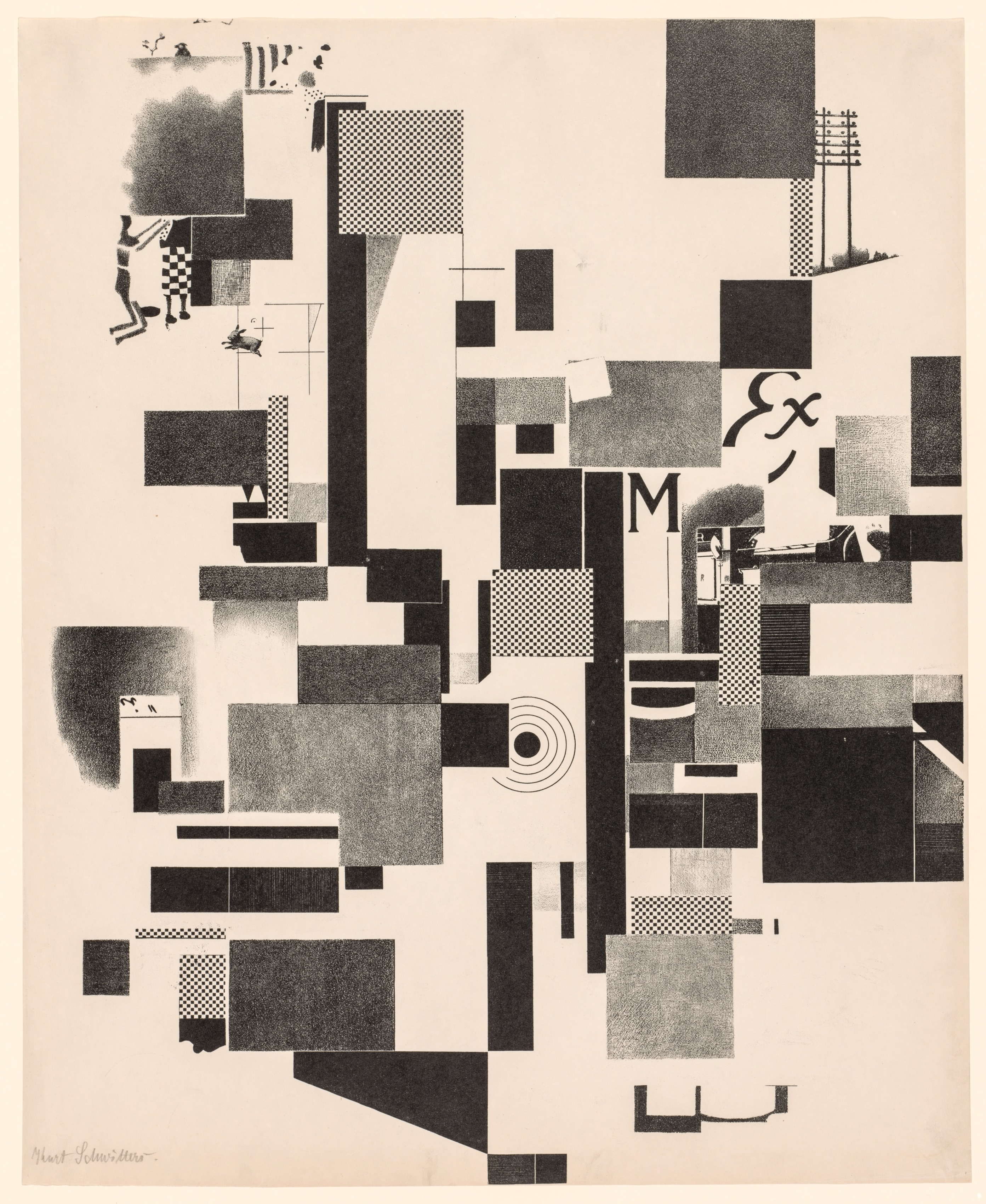
German artist Kurt Schwitters developed a practice known as Merz, incorporating fragments of paper, tickets, packaging and other found objects.
His compositions transformed everyday remnants into abstract arrangements of colour, texture and form.
The original purpose of each material was no longer necessarily important.
A bus ticket might become a rectangle of colour.
Printed lettering could function as a geometric shape.
A fragment of packaging might contribute an unexpected surface.
The process depended on looking at ordinary objects differently.
Materials that appeared worthless could become visually valuable.
This approach challenged conventional assumptions about artistic craftsmanship.
An artwork did not always need to begin with expensive materials or a pristine canvas.
It could develop through collecting, selecting and rearranging things already in existence.
The artist's role shifted.
Creating an image no longer required producing every individual element.
It could involve discovering relationships between materials that had previously belonged to different worlds.
Henri Matisse: Drawing With Scissors
Decades later, French artist Henri Matisse transformed cut paper into something remarkably different.
During the later years of his life, Matisse experienced significant health difficulties that limited his ability to work in familiar ways.
He increasingly turned towards compositions made from coloured paper.
Studio assistants painted large sheets with vivid gouache.
Matisse then used scissors to cut the paper into shapes.
Some resembled leaves, flowers, figures or objects from the natural world.
Others were more abstract.
The forms were arranged, repositioned and eventually fixed into compositions.
Matisse developed an extraordinary visual language through these apparently simple materials.
Bold colours occupied large, uninterrupted areas.
Curving shapes created rhythm.
The empty spaces between them became as important as the paper itself.
Unlike the political fragments of Dada photomontage, Matisse's cut-outs often appeared joyful and remarkably direct.
Their simplicity was deceptive.
Each shape required careful decisions about proportion, movement and colour.
The works demonstrated that cutting paper could become as expressive as drawing or painting.
The Extraordinary Simplicity of The Snail
One of Matisse's most memorable cut-outs is The Snail, created in 1953.
The composition consists of large pieces of coloured paper arranged across a pale background.
Orange, purple, blue, green, pink and other tones form a loose spiral.
There is no realistic depiction of an animal.
No carefully drawn shell.
No naturalistic background.
Instead, the arrangement suggests the movement and structure of a snail through relationships between simple coloured shapes.
The result feels surprisingly immediate.
The viewer recognises a sense of energy and organisation without needing a detailed representation.
Matisse had reduced the subject to something approaching its essential visual character.
The work also reveals the importance of scale.
These were not necessarily small paper experiments intended to remain inside sketchbooks.
Matisse's cut-outs eventually developed into substantial works that could influence the atmosphere of entire rooms.
Paper had become an architectural and artistic material.
Something ordinary had acquired extraordinary possibilities.
Romare Bearden: Building a World From Fragments
In the United States, artist Romare Bearden developed an approach to collage rooted in memory, cultural identity and everyday experience.
Born in North Carolina in 1911, Bearden spent much of his youth in New York, where his family had connections with the creative communities of the Harlem Renaissance.
His work frequently explored African American life, drawing upon experiences, photographs, music and cultural history.
Bearden combined fragments of printed imagery with coloured paper, paint and other materials.
His figures were often constructed from unexpected combinations of shapes.
Faces contained photographic fragments.
Bodies seemed to occupy several perspectives simultaneously.
The compositions reflected influences from Cubism, but Bearden developed a distinctive approach focused on human experience.
Rather than using fragmented imagery simply to explore abstract form, he employed it to communicate stories about people and communities.
His work could be intimate, vibrant and deeply expressive.
And in 1971, he created one of his most remarkable achievements.
A Whole Neighbourhood in One Artwork
Bearden's The Block is an enormous collage extending approximately five and a half metres across six panels.
The composition depicts a section of Harlem inspired by buildings along Lenox Avenue.
At first glance, it resembles a colourful streetscape.
Apartment buildings stand alongside shops and other neighbourhood spaces.
But look more closely, and an extraordinary collection of stories begins to emerge.
Windows reveal private interiors.
People gather on pavements.
Figures appear in doorways.
Different activities unfold simultaneously.
The buildings become containers for individual lives.
Bearden combined printed papers, photographic fragments and painted surfaces to create a composition in which public and private experiences exist together.
The artwork captures the energy of a neighbourhood without attempting to reproduce it through conventional realism.
Different scales and perspectives coexist.
Religious imagery appears alongside everyday street scenes.
The result feels like a combination of observation, memory and imagination.
It is a portrait of a place assembled from fragments.
And perhaps that is what makes collage especially appropriate to Bearden's subject.
A neighbourhood is not experienced through one image or moment.
It is remembered through countless details.
Faces, buildings, conversations, music and ordinary routines.
Bearden brought those fragments together into a single extraordinary composition.
Wangechi Mutu: Creating New Identities
Contemporary artists continue using collage to challenge familiar ways of representing the human body.
Kenyan-born artist Wangechi Mutu has developed a distinctive practice combining photographic fragments, drawing, paint and other materials.
Her works frequently create fantastical figures whose bodies appear assembled from different sources.
Images taken from fashion magazines, medical publications and popular media become parts of unfamiliar characters.
The resulting figures can seem simultaneously beautiful, unsettling and powerful.
One important example is Preying Mantra, created in 2006.
Its layered imagery explores ideas surrounding gender, representation and cultural identity.
Mutu's approach demonstrates how collage can question the images that society produces and circulates.
Fashion photography, advertising and other mass-media imagery often present particular ideas about beauty and the body.
By cutting those images apart and combining them differently, Mutu challenges their apparent certainty.
The fragments no longer communicate the messages for which they were originally created.
They become part of another narrative.
The technique connects contemporary concerns with the experimental approaches developed by earlier collage artists.
The materials may change.
But the possibility of questioning familiar images remains central.
Collage in the Digital World
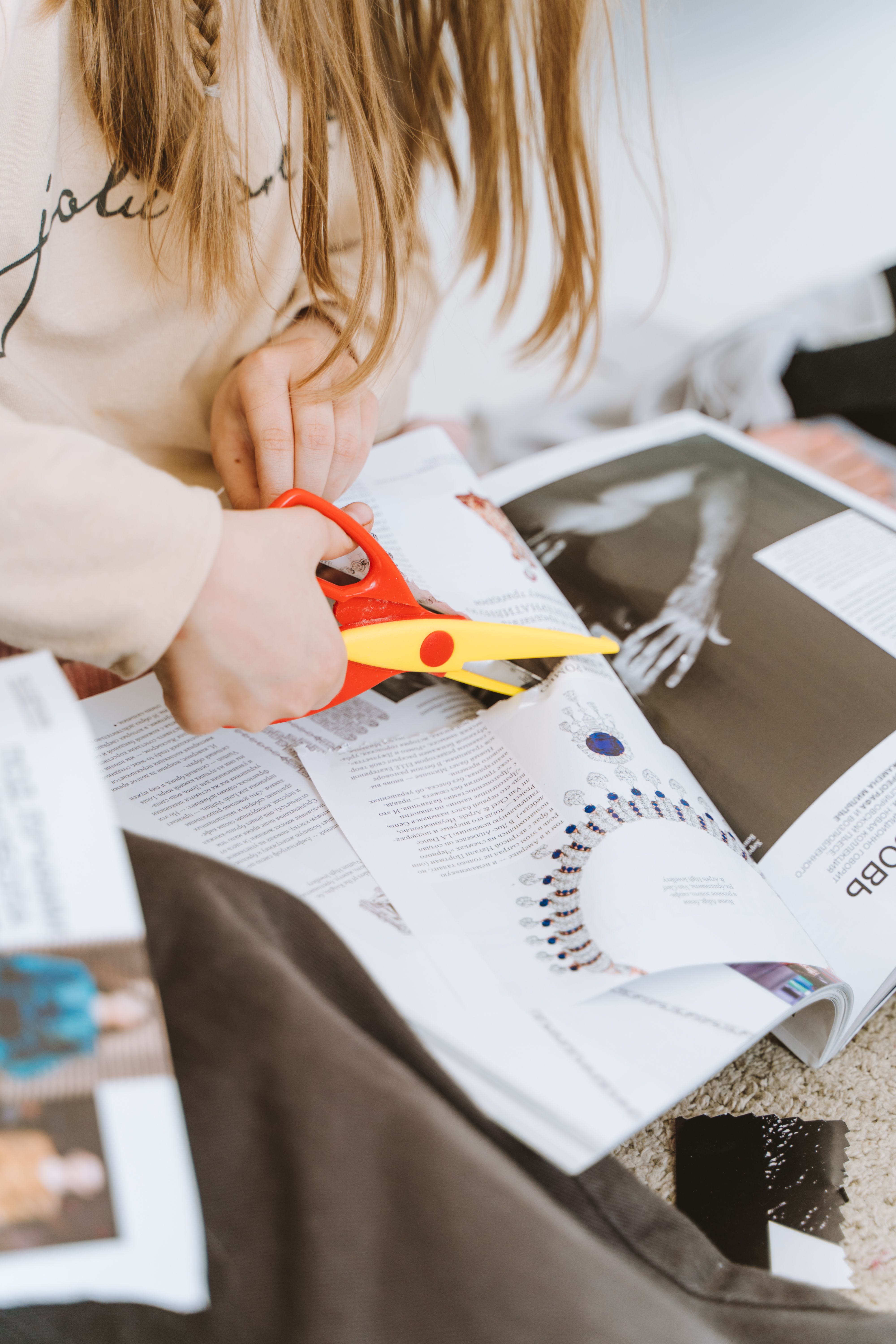
Today, creating a collage no longer requires scissors, glue or a physical collection of magazines.
Digital editing tools allow artists to combine photographs, textures, illustrations and typography on a screen.
Images can be resized, recoloured, duplicated and rearranged almost instantly.
The possibilities are extraordinary.
An artist can create compositions using photographs from different places and periods.
A digital collage may combine hand-drawn marks with scanned materials and entirely computer-generated elements.
The creative process can become highly flexible.
But the fundamental principle remains familiar.
Existing visual elements are brought together to create a new relationship.
Digital tools have also introduced new questions.
Images circulate widely online, often separated from information about their creators.
The ability to download and manipulate a photograph does not automatically provide permission to republish it.
Artists working with found imagery must still consider copyright, attribution and the cultural context of their sources.
These concerns are particularly important when images depict people or communities whose representation carries wider significance.
Collage has always involved transforming existing material.
Contemporary technology has made that process easier, but it has not removed the responsibilities associated with it.
Why Fragments Can Tell Better Stories
There is something particularly compelling about an artwork that does not attempt to present a seamless reality.
A collage allows different images, moments and perspectives to exist together.
Its visible edges can become part of its character.
A photograph may end abruptly.
A piece of paper might overlap another.
An unexpected colour can interrupt an otherwise familiar scene.
These interruptions remind viewers that the image has been constructed.
Yet that apparent incompleteness can make the composition more expressive.
Memory often works through fragments.
We remember particular faces, places and moments rather than an uninterrupted account of the past.
Our understanding of a city develops through countless experiences.
And our identities are influenced by different cultures, relationships and histories.
Collage offers a visual language well suited to these complexities.
It does not need to pretend that everything fits together perfectly.
Sometimes, the visible joins are what make the work interesting.
Making Something New From What Already Exists
The history of collage demonstrates how a remarkably simple technique can produce very different artistic achievements.
Picasso and Braque introduced everyday materials into modern painting.
Hannah Höch transformed newspaper photographs into sharp political criticism.
Kurt Schwitters found creative possibilities within discarded objects.
Henri Matisse created extraordinary compositions from painted paper and scissors.
Romare Bearden assembled the memories and experiences of a neighbourhood into a monumental artwork.
Wangechi Mutu continues to use fragments of contemporary imagery to challenge established representations of identity.
Their works differ enormously.
Yet each begins with the possibility that existing materials can communicate something new when their relationships change.
A photograph can acquire another meaning.
A piece of printed paper can become a work of abstraction.
An ordinary object can become part of an artistic composition.
Perhaps that is what makes collage such an enduring medium.
It encourages a different way of looking at the world.
Things do not always need to be created from nothing.
Sometimes, imagination begins with what is already there.
A fragment.
An unexpected combination.
A decision to move one piece somewhere else.
And the discovery that, together, those pieces can tell an entirely different story.
Further Reading
Seeing Isn't Believing: The Art of Illusion
From Renaissance paintings with hidden secrets to optical art and impossible swimming pools, exploring how artists have spent centuries challenging the way we see the world.
By Culturefold Editors
The Rooms Where Art Begins
From Francis Bacon’s chaotic London workspace to the carefully arranged sculptures of Constantin Brancusi, exploring the remarkable places where artists create their work.
By Culturefold Editors
The Colour That Changed Art
From precious pigments and Renaissance masterpieces to Picasso's melancholy paintings and Yves Klein's extraordinary blue canvases, the remarkable story of a colour that has fascinated artists for centuries.
By Culturefold Editors