
Fez: The City Made by Hand
Behind the ancient walls of Morocco's cultural capital lies an extraordinary world of narrow streets, intricate architecture and traditional craftsmanship. A city where history is not simply preserved, but practised.
At first, Fez can feel almost impossible to understand.
Narrow streets twist between tall buildings. Small workshops open directly onto busy passageways. The sound of metal being struck echoes from somewhere around a corner, while the scent of leather, spices and freshly prepared bread drifts through the air.
There are few obvious landmarks to guide the unfamiliar visitor.
A passage may lead into a crowded market, a quiet residential street or an unexpectedly beautiful courtyard.
And behind relatively plain exterior walls, some of Morocco's most extraordinary architectural interiors remain hidden from view.
Fez is a city that reveals itself gradually.
Located in northern Morocco, it is celebrated for its historic medina, religious institutions and remarkable traditions of craftsmanship.
The ancient city, known as Fez el-Bali, contains a dense network of streets, homes, markets and workshops that developed over many centuries.
Its architecture reflects different dynasties, cultural influences and periods of prosperity.
But perhaps its most fascinating characteristic is that many traditional activities have continued within the same urban environment.
Leather is still worked by hand.
Ceramic tiles are carefully shaped and assembled into geometric patterns.
Woodworkers produce carved architectural details using skills developed through generations of practice.
Fez is not simply a collection of historic monuments.
It is a place where the relationship between people, materials and tradition remains visible in everyday life.
A City Built Across Centuries
The origins of Fez date to the late eighth and early ninth centuries, when settlements were established under the Idrisid dynasty.
Its position helped it develop into an important centre of commerce, religion and learning.
Over time, the city attracted people from different regions, including communities with connections to Al-Andalus and Kairouan in present-day Tunisia.
These influences contributed to its distinctive cultural identity.
During the thirteenth and fourteenth centuries, Fez experienced a particularly significant period under the Marinid dynasty.
Important religious and educational buildings were constructed, while the city expanded through new residential and administrative districts.
In 1276, the Marinids established Fez el-Jdid, a new fortified settlement to the west of the older city.
It became home to the royal palace and important political institutions.
The two historic districts developed alongside one another, forming an urban environment of extraordinary complexity.
In 1981, UNESCO recognised the Medina of Fez as a World Heritage Site.
The designation acknowledged its exceptional architectural heritage and the continuity of urban traditions developed across more than a thousand years.
Yet the city's importance cannot be measured through age alone.
What makes Fez remarkable is the way its history continues to influence the organisation of everyday life.
The Medina Without Cars
One of the most distinctive characteristics of Fez el-Bali is its narrow network of pedestrian streets.
Much of the historic centre is inaccessible to ordinary motor vehicles.
The lanes were established long before modern transport, and many remain too narrow for cars.
Goods move through the medina using handcarts and, in some areas, pack animals.
A delivery might involve navigating several turns, avoiding pedestrians and squeezing through a passage scarcely wider than the cart itself.
For visitors, the experience can feel like entering a different urban rhythm.
Traffic noise gives way to conversation, footsteps and the activity of workshops.
But the absence of cars is not simply a picturesque characteristic.
It creates practical challenges for residents and businesses.
Deliveries require more effort.
Building maintenance can be difficult.
Emergency access, waste collection and infrastructure improvements must accommodate the historic street layout.
The same urban form that makes Fez extraordinary also complicates its modern operation.
This tension is central to the city's identity.
Preserving its character requires maintaining a functioning environment for the people who live and work there.
The Famous Tanneries
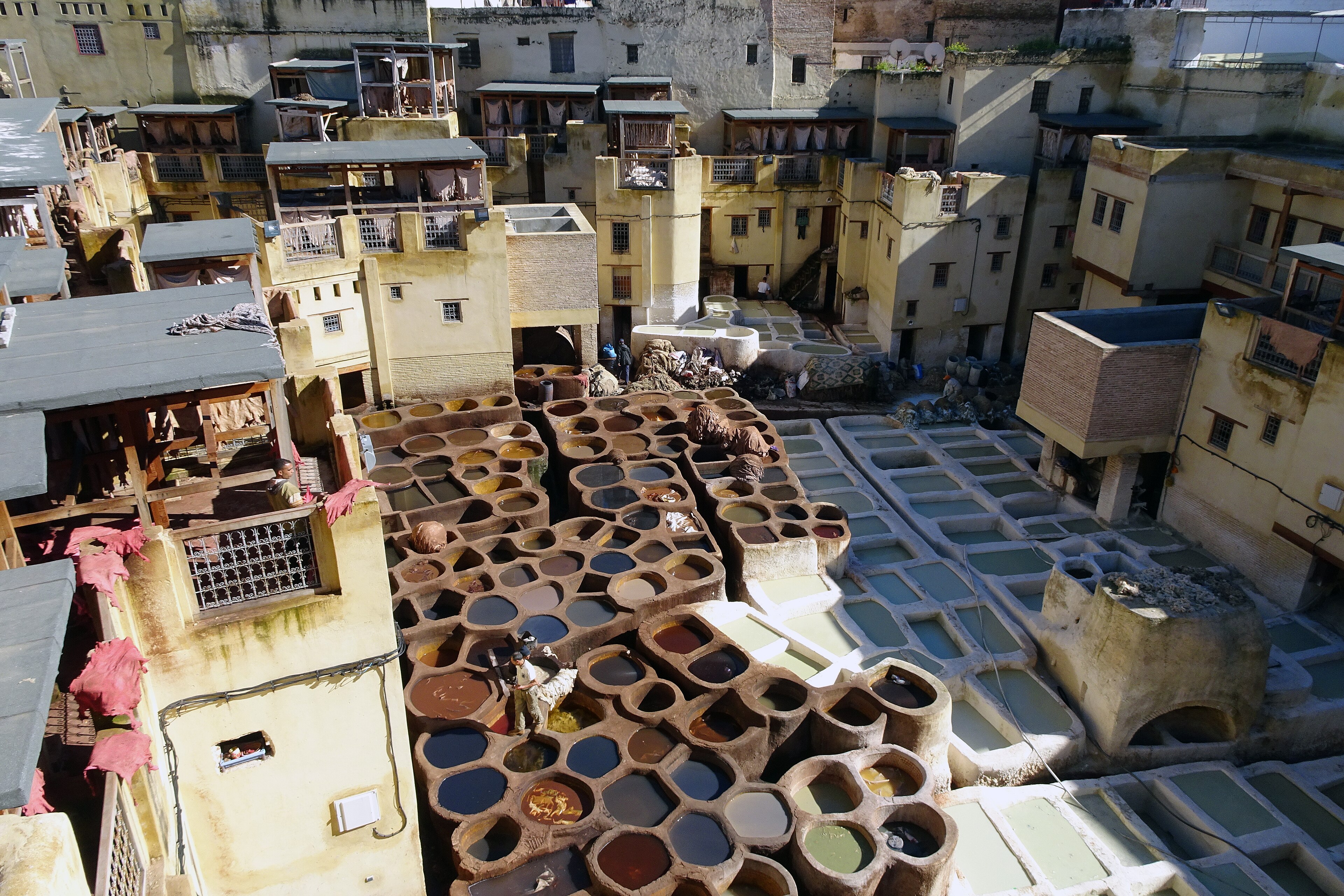
Few places communicate Fez's relationship with traditional craftsmanship more immediately than the Chouara Tannery.
Viewed from the surrounding terraces, the site appears as an extraordinary arrangement of stone vats.
Circular and rectangular basins form a dense pattern across the courtyard below.
Some contain pale liquids used during the preparation of animal hides.
Others hold colouring solutions in shades of brown, yellow, red and other tones.
Workers move between the vats, handling materials through processes requiring considerable experience and physical effort.
Leather production has formed part of Fez's economy for centuries.
The work traditionally involves several stages, including cleaning, softening, treating and colouring hides before they are dried and prepared for further use.
The resulting material is transformed into bags, footwear and other leather goods.
From above, the tannery can resemble an elaborate piece of abstract art.
But the visual spectacle should not obscure its reality.
This is a working industrial environment.
The processes are physically demanding, and historic tanning practices can involve difficult working conditions and environmental challenges.
For the people employed there, the vats are not simply a tourist attraction.
They are a workplace and a source of livelihood.
That distinction is important.
The tannery's cultural significance lies not only in its appearance, but in the knowledge and labour behind the finished products.
The Art of Zellige
Another important element of Fez's artistic identity can be found across its historic buildings.
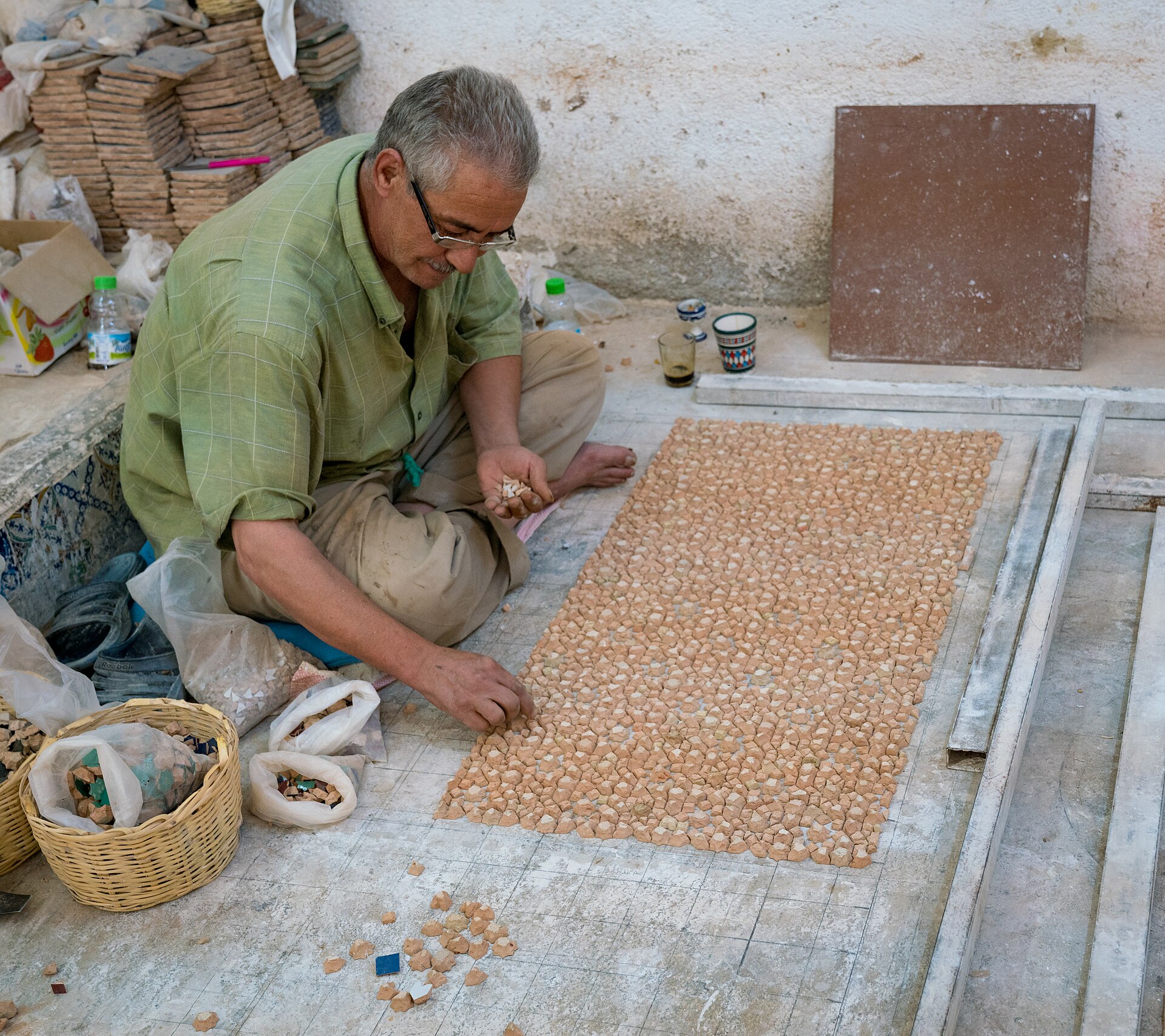
Zellige is a traditional form of Moroccan mosaic tilework created using carefully cut pieces of glazed ceramic.
Small shapes are arranged into intricate geometric compositions.
Stars, polygons and repeating patterns create surfaces of extraordinary visual complexity.
The technique requires precision.
Artisans prepare and cut tiles into specific forms before arranging them into larger designs.
A slight variation in one piece can affect the alignment of the surrounding pattern.
The completed compositions may cover walls, fountains, floors or architectural details.
Their geometry can appear almost mathematical.
Yet the finished surface retains the subtle character of something made by hand.
Tiny differences in glaze, colour and texture give the patterns visual depth.
In Fez, zellige is especially prominent within religious and educational buildings, as well as traditional homes.
Its use reflects the relationship between craftsmanship and architecture.
The decoration is not simply applied after the building is complete.
It contributes to the identity of the space.
And it demonstrates how repeated geometric elements can produce something extraordinarily sophisticated.
The Courtyards Behind the Walls
Walking through Fez, it is easy to underestimate the buildings surrounding the narrow streets.
Many traditional houses present relatively modest exterior facades.
Their most elaborate architectural features are concealed within.
Pass through a doorway, however, and the experience can change completely.
A central courtyard opens towards the sky.
Decorated walls surround an intimate interior space.
Carved plaster, painted timber and ceramic mosaics create a combination of colour and texture.
The arrangement reflects an architectural tradition in which domestic life is organised around an internal courtyard rather than displayed towards the street.
Rooms open onto the central space.
Light enters from above.
The courtyard provides a degree of privacy while contributing to ventilation and the organisation of family life.
Some historic houses have been restored as guest accommodation or cultural spaces.
Others remain private residences.
The contrast between exterior restraint and interior decoration reveals something important about Fez.
Its architectural identity cannot be appreciated simply by looking at building facades.
Some of its most remarkable spaces remain hidden behind ordinary doors.
Al-Qarawiyyin: A Centre of Learning
Fez also developed an extraordinary intellectual and spiritual reputation.
At the heart of that history stands Al-Qarawiyyin, one of the city's most important religious and educational institutions.
Its origins date to the ninth century.
According to a longstanding historical tradition, Fatima al-Fihri, a woman from a family associated with Kairouan, founded the mosque around 859.
The details of its early foundation remain a subject of historical study, but the institution's importance is unmistakable.
Over subsequent centuries, Al-Qarawiyyin became a major centre of religious scholarship and intellectual activity.
Its influence extended beyond Morocco, contributing to wider networks of learning across North Africa and the Mediterranean.
The surrounding city developed institutions connected with education, religious life and the movement of scholars.
This intellectual tradition helped establish Fez's reputation as a cultural capital.
It also contributed to its architectural development.
Schools, libraries, mosques and other important buildings became part of the urban environment.
Knowledge and craftsmanship developed alongside one another.
One shaped the intellectual life of the city.
The other helped give that life a physical setting.
The Beauty of the Madrasas
Among Fez's most remarkable architectural spaces are its historic madrasas, educational institutions closely associated with the city's Islamic scholarly traditions.
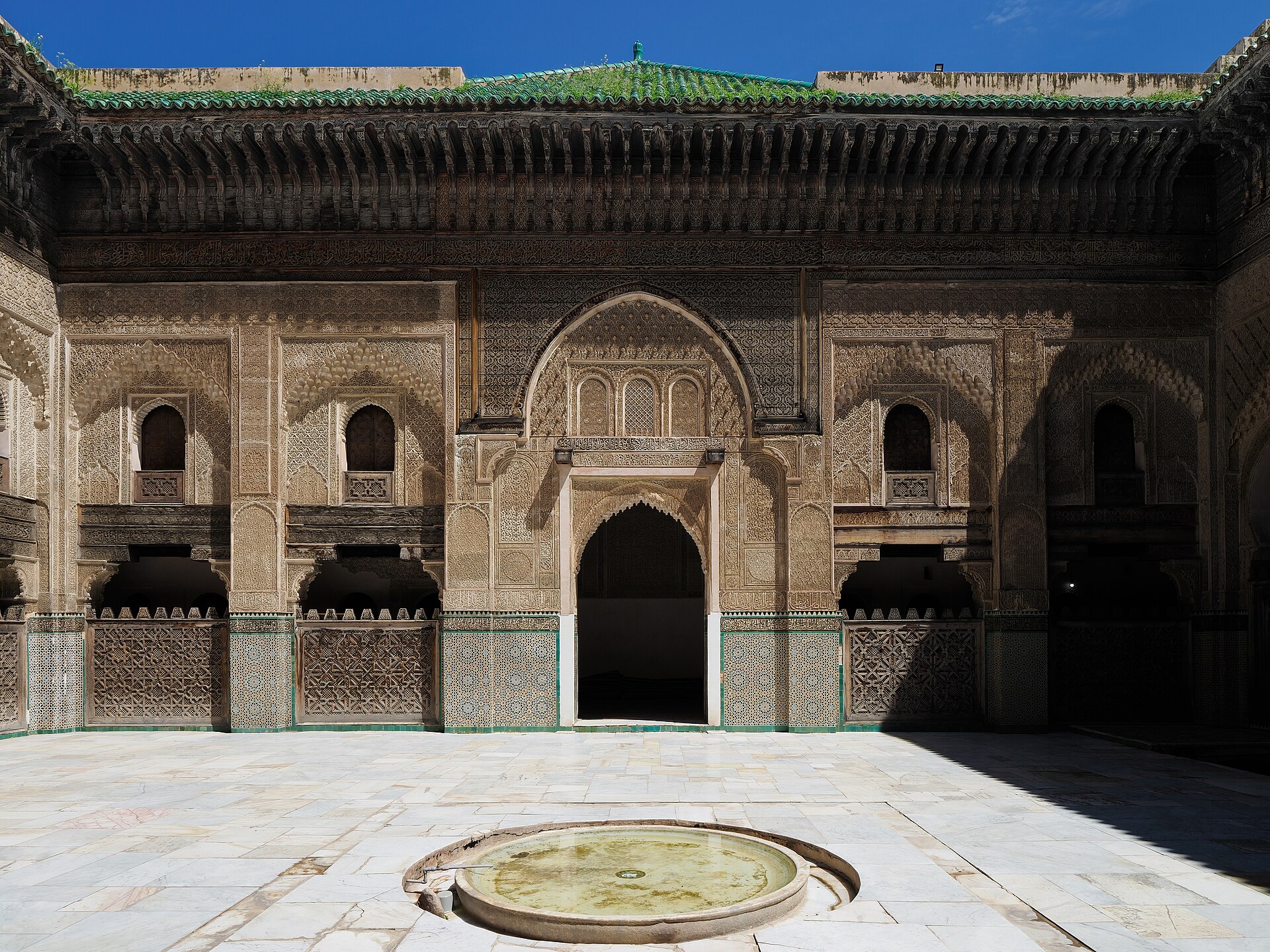
The Bou Inania Madrasa, constructed during the fourteenth century, is an extraordinary example of Marinid architecture.
Its courtyard contains elaborate zellige tilework, carved plaster and finely detailed timber.
The different materials work together to create a carefully balanced composition.
Lower sections of the walls contain geometric ceramic patterns.
Above them, intricate carved surfaces introduce different textures and forms.
Wooden architectural details provide warmth and depth.
The Al-Attarine Madrasa offers another remarkable demonstration of similar craftsmanship.
Its richly decorated courtyard reveals how architectural surfaces could become opportunities for extraordinary artistic expression.
These buildings were not merely decorative monuments.
They were places associated with education and religious study.
Their architecture reflected the cultural importance attached to those activities.
The result is an unusual relationship between learning and beauty.
The buildings communicate the significance of knowledge through the care invested in their construction.
A City of Workshops
Beyond its celebrated monuments, Fez retains another kind of architectural environment.
The workshop.
Throughout the medina, small spaces accommodate activities ranging from metalworking to textile production and woodcarving.
The organisation often reflects traditional commercial patterns, with related trades concentrated in particular areas.
In one passage, metalworkers shape and decorate copper or brass.
Elsewhere, shops display woven fabrics, carved wooden objects and ceramic products.
The work frequently takes place within view of the street.
A visitor can encounter the different stages of production simply by walking through the neighbourhood.
The process reveals the human effort behind objects that might otherwise appear as finished products in a shop.
Materials are measured, cut, shaped and assembled.
Tools acquire wear through repeated use.
Skills develop through observation and practice.
Some workshops continue family traditions established over generations.
Others adapt their products to meet contemporary demand.
Together, they contribute to an economy in which craftsmanship remains closely connected to the physical city.
The Importance of the Mellah
Fez's cultural history is also inseparable from its Jewish communities.
In Fez el-Jdid, the Mellah developed during the fifteenth century as an important Jewish neighbourhood.
Its streets and buildings preserve traces of a community that contributed to the city's economic, social and cultural life.
The area has an architectural character that differs in places from the older medina.
Certain residential buildings feature projecting balconies and windows facing the street.
Religious sites, cemeteries and surviving historic structures reflect the long history of Jewish life in Fez.
The Jewish population declined significantly during the twentieth century, particularly through migration.
But its cultural heritage remains an essential part of the city's story.
The establishment of a Museum of Moroccan Jewish Culture within the Mellah reflects efforts to document and interpret that history.
It is an important reminder that Fez was shaped by more than one community or cultural tradition.
Its identity emerged through centuries of interaction between different populations.
Understanding the city requires recognising those contributions.
The Challenge of Preservation
Fez's historic importance has created substantial responsibilities.
Many buildings within the medina are centuries old.
Traditional construction materials require specialist knowledge to maintain.
Changing living standards demand modern infrastructure that can be difficult to introduce into narrow historic environments.
Restoration projects have sought to protect important monuments, improve public spaces and support traditional crafts.
But preserving individual buildings is only one part of the challenge.
The historic medina remains a residential and commercial environment.
Its future depends on the people who inhabit it.
A beautifully restored facade offers limited benefit if surrounding homes remain unsafe or essential services are inadequate.
Similarly, traditional craftsmanship cannot survive through admiration alone.
Artisans need viable businesses, appropriate working conditions and younger generations willing and able to learn their skills.
Tourism can provide economic opportunities, but it can also influence which crafts remain profitable and how products are made.
The challenge is balancing heritage protection with the realities of contemporary life.
A living city cannot remain completely unchanged.
Nor should it be expected to.
The View from Above
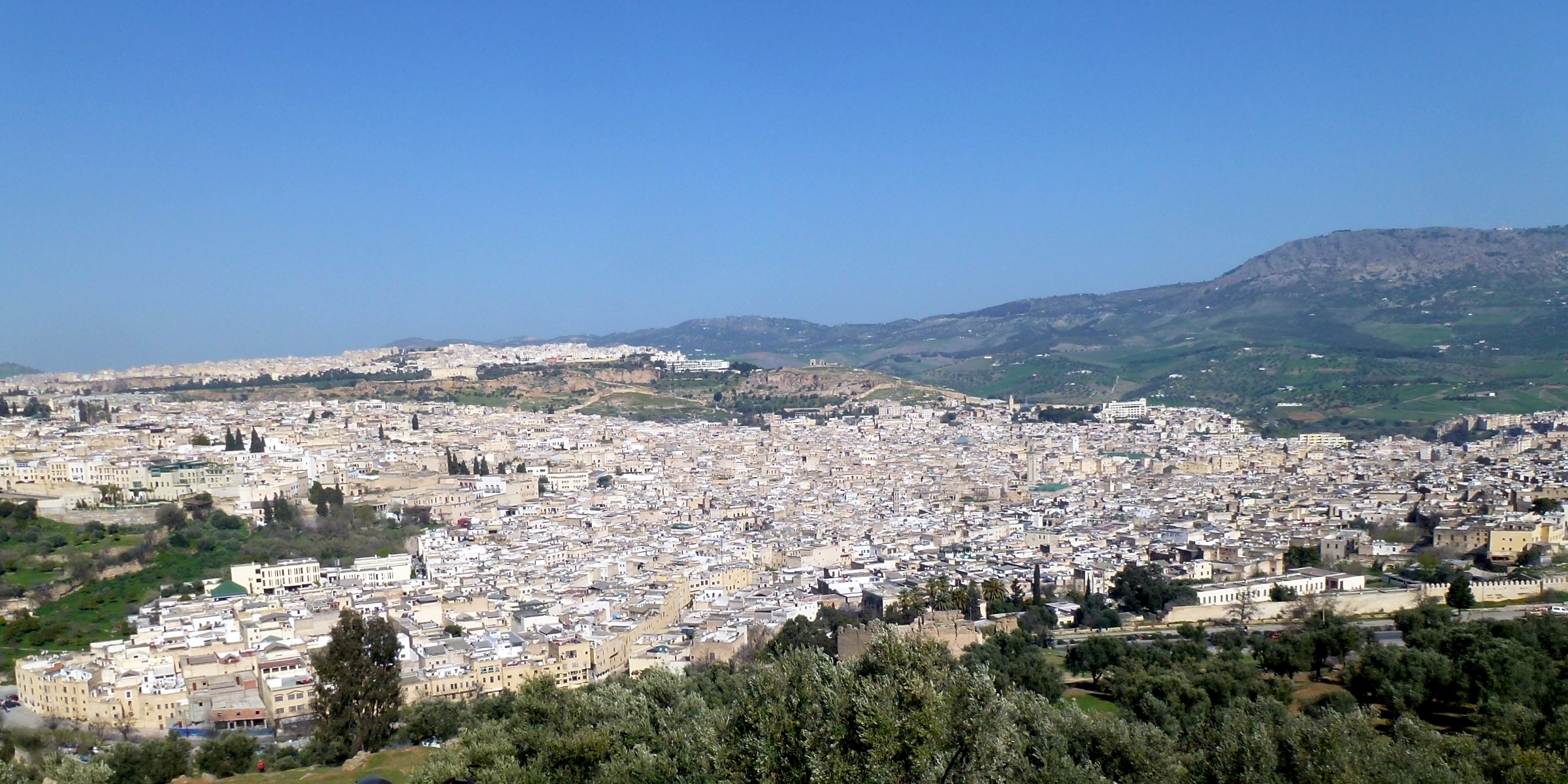
One of the most revealing ways to understand Fez is to look across the medina from a higher viewpoint.
From the hills to the north, the city appears as an enormous arrangement of pale buildings stretching across the landscape.
Green-tiled roofs punctuate the dense urban fabric.
Minarets rise above the surrounding houses.
The streets themselves are often almost invisible.
They disappear into the narrow spaces between buildings.
From this distance, the complexity becomes clear.
Fez is not organised around a single grand avenue or monumental square.
Its character comes from the accumulation of smaller spaces.
Homes, workshops, religious buildings and markets exist in close proximity.
The city appears as a continuous architectural fabric.
But descend into the streets, and the view changes completely.
The rooftops disappear.
The scale becomes intimate.
A carved doorway, a small fountain or the sound of somebody working nearby becomes the focus of attention.
Fez is experienced through these changes in perspective.
From above, it is a remarkable historic landscape.
At street level, it becomes a collection of individual lives and activities.
What It Means to Keep Making Things
The most interesting thing about Fez may not be any single building or famous landmark.
It is the continued relationship between the city and the people who make things within it.
A ceramic pattern reflects knowledge developed through repeated practice.
A carved wooden panel reveals years of training and careful attention to material.
A leather bag carries the work of several different craftspeople.
These objects may eventually travel far beyond Morocco.
But their origins remain connected to particular workshops, techniques and communities.
That relationship is increasingly significant in a world where so many products are manufactured far from the people who eventually use them.
Fez offers opportunities to encounter the process more directly.
The finished object and the place of production can remain closely connected.
Yet maintaining that connection requires more than celebrating traditional craftsmanship as something beautiful.
It requires recognising the livelihoods, expertise and contemporary challenges of the people involved.
Their work is not simply a performance of history.
It is part of the city's present.
A City Still Being Written
Fez is often described as a place where time has stood still.
The expression is understandable.
Its narrow streets, historic buildings and traditional crafts create an atmosphere that feels unusually connected to the past.
But the description misses something essential.
Fez has never stopped changing.
Its earliest settlements developed into an important imperial centre.
New neighbourhoods appeared.
Religious institutions expanded.
Commercial networks evolved.
Crafts adapted to new materials, customers and economic circumstances.
Today, restoration, tourism and modern urban life continue shaping the city.
Its heritage survives not because nothing has changed, but because generations of people have found ways to maintain and adapt what matters to them.
Perhaps that is what makes Fez extraordinary.
The city contains beautiful monuments, remarkable craftsmanship and an urban landscape unlike almost any other.
Yet its greatest achievement may be less visible.
It has preserved a relationship between human skill and the places where that skill is practised.
Within the medina, a wooden door is still carved.
A tile is still shaped by hand.
A piece of leather is still transformed into something useful.
These ordinary activities connect the present to a much longer history.
And they remind us that cultural heritage is not always something kept behind glass.
Sometimes, it is something people continue to make.
Further Reading
Valparaíso: A City Painted on the Hills
Colourful houses, extraordinary street art and century-old hillside lifts define this Chilean port city. But beyond its vibrant appearance lies a fascinating history of trade, creativity and resilience.
By Culturefold Editors
Mexico City: A City of Many Lives
From ancient Tenochtitlan to Bellas Artes, Barragán and the canals of Xochimilco, Mexico City reveals itself in layers.
By Culturefold Editors
Lisbon: A City Written in Tiles
From azulejo-covered facades and Alfama’s winding streets to MAAT’s waterfront architecture, discovering the histories and everyday life that shape Lisbon.